Echoes of Faith: The Cultural Significance of Maa Lankeswari

By;Siddharth Saswat Panda
Junagarh,Kalahandi,Odisha
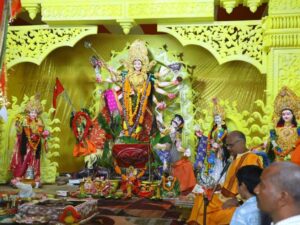
Maa Lankeswari, revered as the presiding deity of the town of Junagarh in Kalahandi district, Odisha, holds a special place in the spiritual and cultural fabric of the region. Nestled within the ancient temple located in the heart of the town, Maa Lankeswari is worshipped as a powerful manifestation of the Goddess Durga. The temple, believed to be centuries old, attracts devotees from across Odisha and beyond, especially during festivals like Durga Puja and Chaitra Navratri.
The deep-rooted traditions, rituals, and myths surrounding Maa Lankeswari reflect the region’s rich heritage and the unshakable faith of her followers. This article explores the history, significance, and enduring legacy of Maa Lankeswari, offering a glimpse into the spiritual life that continues to thrive in this sacred corner of Odisha.
As we all know Lankeswari is the presiding deity of Junagarh, the old capital of Kalahandi. Lankeswari is stated by traditions to be the protectress of mythical city Lanka ruled by Ravan referred as Lankini or Lanka devi. Similarly Lankeswari is the presiding deity in the Sonepur region (Paschima Lanka) during the time of chhindakanagas appointed the Telugu chodas as local ruling chief there. Even today Maa Lankeswari is worshiped in the form of a flat rocky islet in the bed of Mahanadi and whirpool of Mahandi is known as “ Lankeswari Darha “.
Junagarh is one of the key historical sites on the bank of Hati River and the Tel River valley and ruin of Soma, Kalachuri, Chhindakanaga, Ganga and Naga dynasties are laying scattered in and around Junagarh. Till the capital was shifted to Bhawanipatna during 1850 AD. It was the capital and nerve centre of Kalahandi as well as Trikalinga area. Junagarh was known as the Koilavatipatna and Jenavalipatna about which there are mentions in “Sarala Mahabharat” also. Evidence of past glory of Junagarh can be found with several Shakta, Shaiva and Vaishnava temples dedicated to Lankeswari, Kanakadurga, Budharaja, Someswar Mahadev and Dadhivamana and other temples. Several Bhairava imagees of different periods from 1st century to 12th century AD and sculpture are laying scattered.
Maa Lankeswari is the presiding deity and treated as veneration by general mass. It is an unique Shakta and Tantric centre and was the tutelary deity of different powers like Chhindakanagas,. Ganga, and Naga dynasties. Many legends are associated with the deity. According to popular legend the Banka Paikas, a warrior community brought Lankeswari from the south by the order of king. Virtually the Banka Paikas defeated the enemy and brought the deity to the capital city at Jenabalipatna now Junagarh by playing Ghumura.
The legend may be related to the period when captured Somavanshi Chhindakanagas kingdom or may be Gangas who defeated Kalachuries. Incidentally it was considered as honour for the victorious kings to bring the deities from subjugated territories to install in their capital. The period of 11th to 13th century A.D. Was marked by great political disturbance was marked by south Kosala and Trikalinga due to continuous warfare between Somavanshi, Kalachuri, and Chhindakanagas and Ganga dynasties and Kalahandi become battle field in the competition among different powers to become Trikalingadhipati. Large number of Sati and hero stones found in Junagarh is indicators of long warfare. Maa Lankeswari is worshiped as War goddess who not only conferring victory and success in the battle field but also participating in the war as per traditions.
Considering the iconographic style scholars assigned the date of a deity in 12th century A.D. Maa Lankeswari has four armed. She sites in Vajraparyanka posture in the lotus throne. She holds Sanka and Chakra in her upper left and right hands respectively and lower right hand having Varada Mudra and left hand is Abhaya Mudra and spread out tongue. The Image is curbed in Black chlorite stone measuring 32“/ 16” . Such iconic feature synchronizing Kali with Vishnu is unique and only of its kind in the state of Odisha. The deity is worshipped with Vanadurga’s Vijamantra .
Infront of the idol of Maa Lankeswari In her abode in Junagarh there is a four handed Kali image (featured- Samaleswari according to local devotees) holding sword and severed head in upper and lower right hands and skull cup and nose in upper and lower left hands respectively dancing over a corpse ( featured- Lord Mahakaal as corpse form ) . As per folklore and traditions from 11th to 18th century A.D the vanquished king were sacrificed, how ever those traditions are of the past.
There are many folklore and legends in the name of goddess Lankeswari. apart from a war goddess she is very lively as well as furious. Local people and many folklore clams that very often Maa Lankeswari use to come out in the form of a young beautiful girl and participate in “Boria dance” along with young girls of the locality. Boria dance is a traditional dance form where girls sings self composed songs without any musical instruments. Another folklore says that one day when the priest reached the temple he found a glass bangle vendor waiting, he said to the priest that, A beautiful young girl came to him from the temple and purchased glass bangles and told him to get the payment from her father. The priest understood the mischief of Goddess Lankeswari and paid the price. Inside the Garvagriha the priest expressed his annoyance to Devi and soon the glass bangles fell down from the Idol. According to folklore because of the deity was so much furious the original idol was buried near the “Deymuhaana” in the confluence of the Bhatrajor and Hatinadi River and a new idol was installed which is based on the “Pratyangira Tantra “ from Srilanka .
The most important festival of maa Lankeswari is Khandabasa on the night of Mulastami. After secret rituals the two ceremonial swords of Maa Lankeswari is placed by the Maharaja of Kalahandi, over two heaps of rice in both side of Alter. People believed that if the sword stands straight the area will be safe from natural calamities and in the event of tilting to any side its indicates bed omen.
After shifting of the capital during 1849-50 AD. to Bhawanipatna due to outbreak of epidemic at Junagarh, the deity Manikeswari at Bhawanipatna become presiding deity of royal family replacing Maa Lankeswari at Junagarh, who was the ancient tutelary deity of the dynasty. However she continues to be the presiding deity of the people of Junagarh. Even today people of all sections incidentally hesitate to falsely swear on name of her.
The present article is entirely research-based and compiled through consultation of multiple publicly accessible reference materials and Historical Books of prominent Authors . The author of this article does not claim exclusive ownership over the foundational facts or intellectual interpretations contained herein. It is also expressly clarified that nothing in this write-up is intended to hurt, insult, or undermine the feelings, beliefs, or sentiments of any person, group, or organisation.)