Scientific Bamboo Harvesting Training Marks Start of Community Forest Economy Pilot in Malkangiri
Bureau,Odishabarta
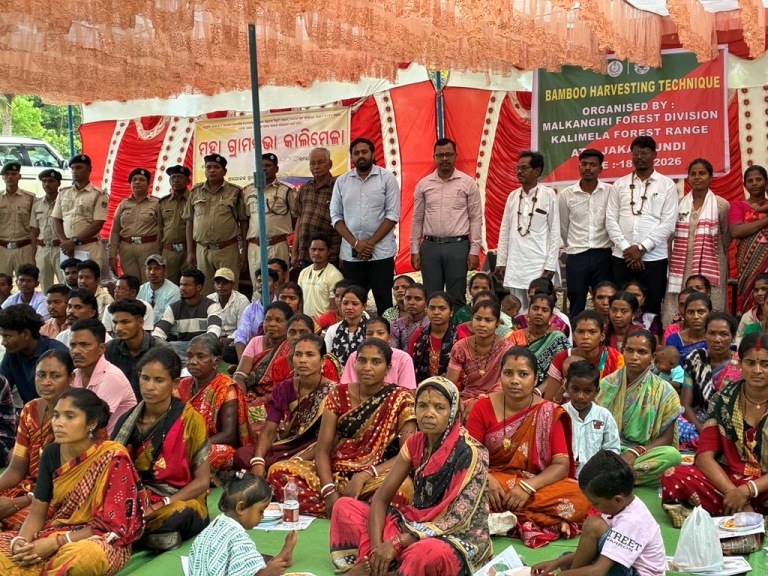
Bhubaneswar, June 2026: A scientific bamboo harvesting training programme was launched at Jakalgundi village, marking the rollout of a unique community-centred bamboo management model that brings together forest conservation, women-led livelihoods, and sustainable local enterprise.
The initiative is being implemented by the Malkangiri Forest Division, Kalimela Forest Range, in collaboration with local Gram Sabhas, the Maha Gram Sabha Kalimela, the Bharti Institute of Public Policy (BIPP) at the Indian School of Business (ISB), and the Kanam Raj Green Shakti Producer Company—a fully women-owned enterprise supported by the Department of Mission Shakti. The pilot is being run with support from the Odisha Bamboo Development Authority (OBDA).
This pilot places tribal women and Gram Sabhas at the centre of production, scientific value addition, and market participation, treating bamboo not merely as a forest resource but as a renewable biological asset capable of supporting both ecological regeneration and rural prosperity.
Speaking on the vision behind the initiative, Professor Ashwini Chhatre, Executive Director, Bharti Institute of Public Policy, Indian School of Business, said, “This pilot represents a grounded model of forest-based transformation. It links scientific harvesting, community governance, women’s enterprise, and market systems into one integrated approach. By placing Adivasi women and Gram Sabhas at the centre, Kalimela can demonstrate how forest economies can generate shared prosperity while maintaining ecological integrity.”
Addressing the participants, Shri Sai Kiran D N, IFS, Divisional Forest Officer, Malkangiri, said, “Sustainable bamboo management requires both ecological discipline and community ownership. Through this training, the Malkangiri Forest Division is working with Gram Sabhas to ensure that harvesting practices support regeneration, protect biodiversity, and create livelihood opportunities without degrading the forest resource. The role of communities is equally critical in wildlife protection and environmental management, and such initiatives can strengthen local stewardship of forests, wildlife, and natural ecosystems.”
The hands-on training programme brought together Gram Sabha leaders, community members, women representatives of the producer company, forest officials, and technical experts from ISB. Participants received practical demonstrations on scientific bamboo harvesting techniques designed to protect the rhizome system and safeguard new shoots, ensuring the long-term regenerative capacity of bamboo clumps.
By combining scientific methodology, community governance, women-led enterprise, and institutional collaboration, the launch marks the beginning of a socially inclusive, ecologically sustainable, and locally owned forest economy model in Malkangiri.