BEYOND THE CERTIFICATES: THE REALITY OF SKILL DEVELOPMENT IN RAYAGADA
Dr.Badal Tah,Odishabarta
Trained in Rayagada, employed in Tirupur: Bridging the divide between target-driven skilling and long-term livelihoods
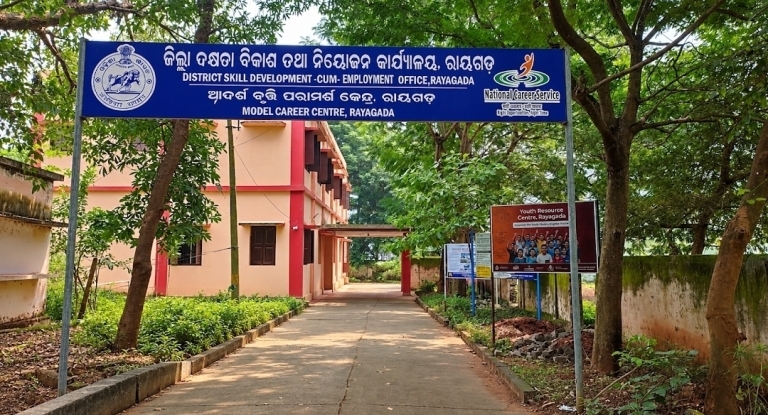
Rayagada, October 2: The official metrics laid before the Odisha Legislative Assembly offer an encouraging picture of rural development: over 2,100 candidates trained, more than 74% placed, and over ₹2.40 crore disbursed to Project Implementing Agencies (PIAs) across Rayagada district over the past three financial years. Yet, cross-referencing these departmental claims with ground realities in blocks like Kashipur, Bissam Cuttack, and Chandrapur exposes deep-seated structural fault lines that run through Odisha’s flagship skill missions, especially in Rayagada.
A closer look at the trajectory of Rayagada’s skilled youth reveals a recurring three-pronged challenge: short-lived private placements, stagnant entry-level wages, and the inevitable reality of distress interstate migration masquerading as formal sector employment. Under the guidelines governing state and centrally sponsored skilling schemes—notably DDU-GKY and PMKVY—PIAs are mandated to track and confirm employment for a minimum window of three months to unlock final funding tranches. In practice, this compliance mechanism distorts the definition of long-term rehabilitation.
While departmental tracking claims impressive retention rates within the first 90 to 180 days, field surveys indicate a sharp drop-off once monitoring ceases. Trainees placed in low-margin textile clusters in Tamil Nadu (Tirupur, Coimbatore) or hospitality hubs in Andhra Pradesh frequently return to their native panchayats within 8 to 12 months.
Training agencies are incentivized on enrollment, certification, and initial placement confirmation. They bear no long-term contractual liability for high attrition rates, workplace safety compliance, or long-term career progression once candidates exit the mandatory monitoring cycle. For a rural youth from Bissam Cuttack or Muniguda, accepting an entry-level placement in an industrial corridor outside Odisha often amounts to economic stagnation.
When basic living expenses consume over 60% of an entry-level wage, the economic incentive collapses. In remote tribal belts, returning to subsistence agriculture, minor forest produce collection, or local unorganized wage labor under MGNREGS frequently matches or exceeds the net disposable income from distant textile or service sector jobs—without the accompanying social dislocation.
Trainees in core technical trades—such as domestic electrical work, fabrication/welding, and two-wheeler automotive repair—exhibit sustained employment and self-employment viability within Rayagada, Jeypore, and Berhampur markets. Local enterprise absorption and independent service work ensure steady incomes of ₹13,000 to ₹18,000 per month. Conversely, high-volume batches churned out in trades like apparel manufacturing and food and beverage (F&B) service rely almost entirely on out-of-state absorption.
Rayagada district, despite hosting heavy industrial presences such as paper mills and alumina refineries, sees minimal local absorption of general skilling graduates due to a mismatch between entry-level service training and the specialized industrial requirements of local plant infrastructure. If public expenditure on skill development in tribal-dominated districts like Rayagada is to yield sustainable social dividends rather than temporary headcounts for assembly scorecards, the policy framework must pivot mandatory tracking to 24 Months & tieing agency performance ratings and future tender eligibility to sustained career stability over two years, rather than a single quarter.
Local industry apprenticeships/internships should be mandated. It requires major industrial corridors and ancillary units in Rayagada, Koraput, and Kalahandi to absorb minimum quotas of local technical trainees under formal state apprenticeship contracts. Emphasis should be shifted to capital-backed self-employment: supplement technical certification in trades like carpentry, electrical, plumbing, fabrication, solar installation, and automotive service with direct micro-credit linkages (PMEGP, Mudra) to cultivate a generation of local entrepreneurs rooted in their home district.
Without these systemic adjustments, skill development initiatives risk operating as a costly public-funded pipeline channeling rural tribal youth into precarious migrant labor, leaving the core developmental challenges of Rayagada unresolved.