Why Has the Legacy of the Parala Maharajas Been Overlooked at Paralakhemundi Railway Station?
Bhagabat Padi | Odishabarta
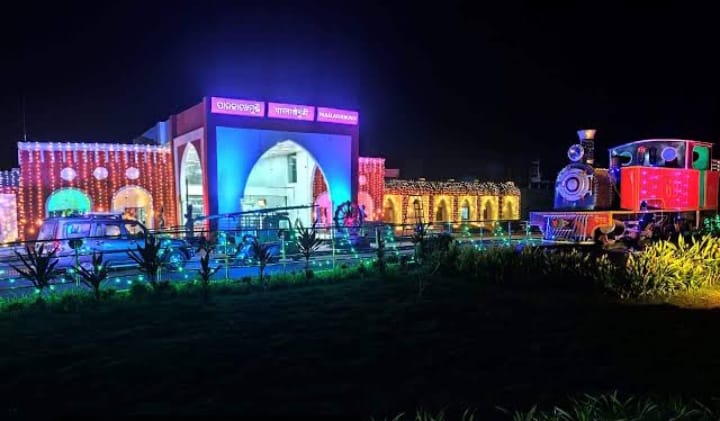
Paralakhemundi, July 22, 2026:The people of Paralakhemundi have expressed deep disappointment over the absence of statues of the erstwhile Parala Maharajas at the newly redeveloped Paralakhemundi Railway Station under the Amrit Bharat Station Scheme, despite their historic contribution to the region’s railway development.
The history of the station dates back to the late 19th century when Maharaja Gourachandra Gajapati reportedly contributed around Rs. 7 lakh from his personal treasury to establish the railway link connecting Naupada to Paralakhemundi through a narrow-gauge line.
The amount was considered enormous for that period and played a crucial role in bringing Paralakhemundi onto the Indian railway map.
Later, during the reign of Maharaja Sri Krushna Chandra Gajapati, the railway line was extended further from Paralakhemundi to Gunupur, significantly improving connectivity in the region. In subsequent years, the narrow-gauge line was converted into a broad-gauge route, further strengthening rail transport.
With the station reportedly generating substantial passenger revenue, local residents had hoped that the Railway Ministry would sanction additional infrastructure, including doubling of the Naupada–Gunupur rail line and the introduction of more passenger and express train services.
Residents welcomed the inclusion of Paralakhemundi Railway Station under the Amrit Bharat Station Scheme, expecting that the redevelopment would also honour the visionaries who laid the foundation of railway connectivity in the region. However, the inauguration of the upgraded station without installing statues of either Maharaja Gourachandra Gajapati or Maharaja Sri Krushna Chandra Gajapati has sparked widespread resentment.
Many residents have drawn comparisons with Khurda Road Railway Station, where a statue of freedom fighter Buxi Jagabandhu Bidyadhar has been installed. They questioned why similar recognition was not extended to the Parala Maharajas, whose contributions to railway development in southern Odisha remain historically significant.
Local citizens also expressed dissatisfaction with what they described as the Railway administration’s reliance on “protocol” while overlooking the region’s heritage. They urged the Divisional Railway Manager (DRM), Rayagada Division, to reconsider the demand and examine the apparent inconsistency in recognising local historical figures.
During the inauguration, local MLA and the Gajapati District Collector reportedly assured the public that the matter would be taken up with the appropriate railway authorities.
The issue has since become a matter of public sentiment across Paralakhemundi, with many residents describing it as an injustice to the legacy of the Parala royal family and the Gajapati dynasty.
Speaking on the issue, educationist Binod Chandra Jena said, “The Railway authorities have failed to honour the invaluable contribution of the Parala Maharajas, leaving the people of Paralakhemundi deeply hurt.”
Senior citizen Ramachandra Padhi said, “We have already submitted a memorandum to the Divisional Railway Manager demanding installation of the statues. However, we remain uncertain about the outcome and hope the authorities will respond positively to our genuine demand.”
Local residents have urged the Railway Ministry and the East Coast Railway administration to install statues of the Parala Maharajas at Paralakhemundi Railway Station as a tribute to their historic role in bringing rail connectivity to the region and preserving its rich heritage.