799 HABITATIONS IN RAYAGADA YET TO BE CONNECTED TO OUTER WORLD

Rayagada (Badal Tah) : Road connectivity in rural India provides significant economic benefits, such as increased agricultural income, easier market access, and job creation, as well as social benefits like improved access to education and healthcare, better public services, and enhanced social interaction and communication. These benefits stimulate rural development and poverty reduction by connecting previously isolated villages to essential economic and social services.
But unfortunately there is no road connectivity in 799 habitations of Rayagada district including 385 approved, 94 under justification, 148 pending verification, and 266 marked ineligible. Interestingly enough, Rayagada is in the category of Aspirational District, where special emphasis is given by GOI. Nevertheless, people still face distressed sale of their agricultural produce. Education is in an abysmal state. Pregnant women and other patients are carried by slings. Beneficiaries walk miles to receive the benefits of Public Distribution System and other social security measures. Poverty reduction is really a sorry state of affairs.
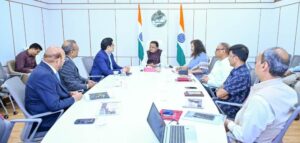
Saptagiri Sankar Ulaka, MP Lok Sabha, who is Chairman, Standing Committee on Rural Development and Panchayati Raj, has taken decisive steps to ensure that the benefits of rural connectivity and infrastructure reach even the most remote corners of this district, where decades of administrative abuse have left hundreds of villages still without proper road access.
“The district administration has failed to address the chronic infrastructure gaps in tribal district like Rayagada. Flagship schemes such as the Pradhan Mantri Gram Sadak Yojana (PMGSY) have fallen short of their intended outcomes, leaving large areas in Rayagada effectively cut off due to poor execution, substandard construction, and
bureaucratic delays”, said Ulaka.
Recognizing the urgency of the situation, the Standing Committee directed the National Buildings Construction Corporation (NBCC) to conduct a comprehensive review of all existing PMGSY roads in Rayagada. Field assessments revealed that several roads recorded as “connected” were either in a dilapidated condition or had been poorly constructed initially. Taking serious note of these findings, the Committee has instructed NBCC to immediately initiate repair and reconstruction work on substandard stretches and to enforce higher technical standards and stricter quality monitoring in future projects, ensuring durable and value-based rural connectivity. Alongside quality assessment, a formal request has been made to the Union Ministry of Rural Development to expedite the approval of pending and justified habitations under PMGSY-IV, based on data verified by District Collector, Rayagada.
The Committee observed that many of the habitations classified as “ineligible” are in difficult, hilly, and predominantly tribal terrains, where standard population criteria do not reflect actual local needs. Denying road access to such areas purely on administrative grounds effectively penalizes communities for their geography. The Ministry has been urged to incorporate greater flexibility for tribal and remote regions, consistent with the Standing Committee’s recent recommendations.
The continuing disconnect between the district administration and the ground realities of tribal communities has resulted in persistent hardship. Delays in the preparation and submission of Detailed Project Reports (DPRs) by the district administration have created a cycle of stagnation, depriving people of essential connectivity. The Committee has formally communicated with the Odisha Government to ensure prompt submission of DPRs, emphasizing that any further delay directly harms the developmental interests of tribal and rural populations.
The Standing Committee on Rural Development and Panchayati Raj reaffirmed its commitment to ensuring that every eligible and deserving habitation in Rayagada receives timely road connectivity, and that all pending and defective road projects are completed without further delay. The Committee underscored that rural connectivity is a cornerstone of inclusive development and that no village will be left behind in the pursuit of equitable growth, dignity, and progress for all.