
TALCHER–ANGUL: POWERING INDIA, POISONING ITS OWN PEOPLE

By Debaranjan Samal,Odishabarta
(Special Investigation)
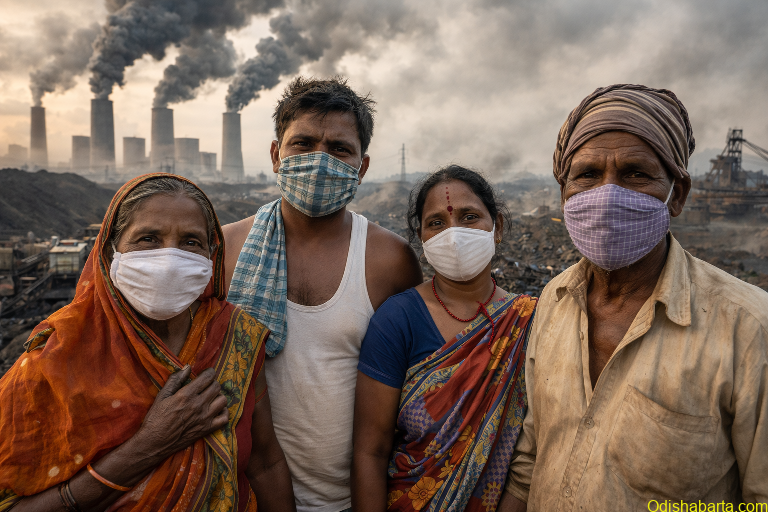
Talcher–Angul, Odisha,(03/-1/226):The air burns the throat before the eyes can adjust to the haze. By dawn, a thin layer of coal dust has already settled on rooftops, water tanks, school playgrounds and human lungs. In Talcher and Angul—one of India’s most energy-critical industrial belts electricity flows to millions of homes across the country, while the people who live here struggle to breathe.
This is the hidden price of India’s power ambition.
An Industrial Giant, A Human Disaster; Talcher–Angul hosts one of Asia’s largest coal belts, housing massive open-cast coal mines, thermal power plants, aluminium smelters, sponge iron units, coal washeries and heavy transport corridors. NTPC’s Kaniha plant, NALCO’s smelter, MCL’s coal mines, and dozens of private industries operate around the clock.
But the prosperity promised by industrialisation has turned into a public health catastrophe.
According to Central Pollution Control Board (CPCB) data, PM10 and PM2.5 levels in Talcher and Angul frequently exceed permissible limits by 3–5 times. Sulphur dioxide, nitrogen oxides and fly ash dominate the atmosphere, while surface and groundwater show alarming levels of heavy metal contamination.
Residents say pollution here is not seasonal—it is permanent.
“We Don’t Breathe Air, We Inhale Coal” In villages like Deulbera, Chhendipada, Banarpal and Talcher town, coughing is normal, breathlessness routine, and inhalers part of daily life.
“Children here learn to cough before they learn to speak,” says Saroj samal local people of Banarpal. “Asthma, skin disease, eye irritation—this is our inheritance.”
Doctors at Angul District Headquarters Hospital confirm a sharp rise in respiratory illnesses, tuberculosis, chronic bronchitis, heart disease and premature deaths. Local health workers quietly admit that cancer cases are increasing, though no comprehensive epidemiological study has been conducted.
Environmental activists allege that the absence of long-term health mapping is deliberate, as official data could expose the true human cost of unchecked industrial pollution.
Water That Poisons, Land That No Longer Feeds Pollution here is not limited to air.(!!!).
Fly ash ponds leak into rivers and farmlands.
The Brahmani river, and its tributaries—once lifelines—now carry industrial discharge.
Farmers complain that crop yields have fallen drastically, soil fertility has reduced, and groundwater has turned unfit for drinking.
“Earlier our wells gave sweet water,” says a farmer from Talcher block. “Now it smells of chemicals. We buy water to drink, while industries use lakhs of litres for free.”
Administration: Silent Spectator or Willing Accomplice (?).
Despite repeated complaints, protests and memorandums, regulatory enforcement remains weak. Pollution Control Board inspections are sporadic, penalties negligible, and violations routine.
Locals accuse authorities of prioritising revenue, royalty and industrial output over human life.
Elected representatives rarely raise the issue forcefully in state or Parliament. When they do, promises replace policy, and files replace action.
Environmental clearance conditions are allegedly violated with impunity—dust suppression systems fail, green belts exist only on paper, and fly ash disposal norms are routinely ignored.
Powering the Nation, Abandoning the People
Talcher–Angul contributes massively to India’s power grid, aluminium exports and industrial growth. But the region itself suffers from inadequate healthcare infrastructure, poor drinking water supply and rising unemployment among displaced families.
This raises a fundamental question (!!).
Can development that destroys lives still be called development?
A Crisis Demanding National Attention
Experts warn that Talcher–Angul is becoming an environmental sacrifice zone, where citizens pay with their health so the rest of the country can enjoy uninterrupted electricity.
What the region urgently needs:
Independent health and environmental impact studies
Strict enforcement of pollution norms Modern pollution-control technology
Compensation and healthcare for affected residents, A transition roadmap towards cleaner energy practices Until then, the smoke will rise, the dust will settle, and the silence will continue.
But history will remember that while Talcher–Angul powered India’s growth, India failed to protect Talcher–Angul’s people.