Hollow City: How MCL Left Talcher Floating Over Underground Voids
DEBARANJAN SAMAL
Associate editor
Sinking City: Talcher’s Handidhua Collapse Exposes Decades of Underground Negligence
Special Investigation | Vacuum Management Failure and the Ghost Mines
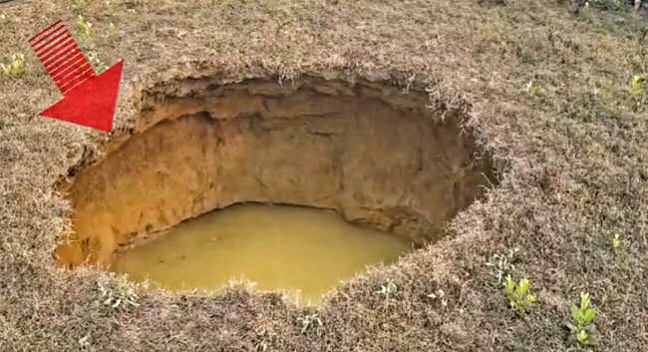
Talcher,( January 30, 2026):Two days after the Handidhua land collapse, district authorities have cordoned off the affected zone with concrete slabs and fencing, while MCL officials have begun a preliminary site inspection. However, no formal subsidence report, rehabilitation announcement, or technical audit order has been made public so far.
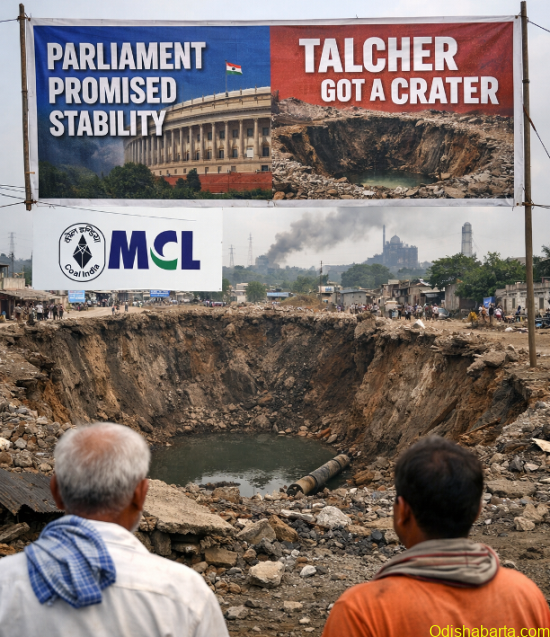
Affected residents continue to demand immediate compensation, relocation, and a scientific safety assessment, warning that cracks are still visible in surrounding areas.
TALCHER; a deafening rumble at dusk. Then the ground gave way.
On January 28, 2026, a massive land collapse in Talcher’s Handidhua area once again dragged India’s largest coalfield into the national spotlight. While the local administration rushed to secure the crater, evidence points to a far deeper failure—one buried beneath decades of unfilled mining voids and broken assurances by Mahanadi Coalfields Limited (MCL.)This was not a freak geological event.It was a long-foretold collapse.(!).
The Anatomy of a Man-Made Disaster;The Handidhua subsidence fits a familiar and dangerous pattern: Goaf collapse, where abandoned underground mine roofs cave in after aging coal pillars lose load-bearing capacity.
Satellite-based Sentinel-1 SAR data has already flagged parts of Talcher sinking at rates of up to –20.1 mm per year, placing the region among India’s most unstable mining belts.
What Went Wrong Underground
• Sand-Stowing Deficit
Underground mines such as Deulabera and Handidhua, operational since the 1920s, followed the Bord and Pillar method. Mining norms mandate that every tonne of coal extracted must be replaced with an equivalent volume of sand to prevent surface failure.
• The “Vacuum Management” Failure
Residents and activists allege that sand-stowing was delayed, partial, or grossly inadequate. MCL’s routine explanation of “faulty construction” fails to explain the scale and depth of the Handidhua crater, pointing instead to the collapse of a large underground void.
• Missed Parliamentary Deadlines
In December 2021, the Union Coal Ministry informed Parliament that sand-stowing in Handidhua and Deulabera would be completed within three to five years.
The 2026 collapse raises a stark question(?)
Were the targets missed—or was the work never structurally sufficient,
A Timeline of Fear: Talcher’s History of Subsidence
1981 – First Warning:
Four acres of paddy land vanished overnight, turning into a deep pond—the first clear sign of underground failure.
2014 – Urban Panic:
A massive cavity opened near the Sai Temple, above the abandoned Deulabera incline.
2018 – Homes at Risk:
A six-foot-wide hole appeared beneath a residence in Handidhua. MCL blamed faulty construction; residents rejected the claim.
2025 – Hingula Collapse:
Vehicles and heavy machinery were buried during a sudden cave-in, narrowly missing workers.
2026 – Handidhua Today:
A fresh crater at Handidhua Chowk now looms over a city where nearly 1.5 lakh residents live atop hollowed ground.
Unanswered Questions for MCL
• Where Is the Sand?
Government data has previously admitted that only 41–42% of underground voids have been backfilled.
The rest remains unaccounted for.
• The No-Construction Paradox
If the Talcher-Angul-Meramandali Development Authority (TAMDA) has declared these zones unsafe, why is there no mass relocation, compensation, or resettlement plan for existing residents?
• The Brahmani River Threat
Geologists warn that a major breach connecting underground voids to the Brahmani River could flood the mine network—destabilising Talcher’s foundation in a single catastrophic event.
Expert Speak
“The Gondwana rock formations of Talcher are inherently fragile. Once Karharbari coal seams are removed and aging coal pillars are left without sand reinforcement, subsidence is not a possibility—it is inevitable. Geological Consultant (name withheld)
What Lies Ahead
As the Handidhua crater stands as a stark symbol of decades of extraction without restoration, pressure is mounting for a high-level technical audit by an independent national or international agency, along with transparent disclosure of backfilling data.
For Talcher’s residents, this is no longer about mining policy.It is about survival.,They are not living on coal..They are living on a hollow promise.