Lankeswari and Junagarh: History, Myth, Archaeology and the Sacred Memory of Kalahandi
Burau,Odishabarta
Junagarh, situated on the right bank of the Hati River within the fertile Tel River valley, stands as a prominent historical centre of western Odisha. The region preserves scattered remains of the medieval Kalachuri, Chindaka Naga, Ganga, and Naga dynasties, reflecting its rich political and cultural heritage. The vestiges of an extensive moat once linked to the Hati River, along with the ruins of palatial complexes, residential settlements, and numerous temples dedicated to Shaiva, Shakta, and Vaishnavite traditions, testify to Junagarh’s former grandeur. The area is further enriched by the presence of Bhairava sculptures, Sati stones, Hero stones, and ancient water tanks, all of which offer valuable insights into its glorious historical past.
Junagarh is renowned for its rich temple heritage, with prominent shrines including those dedicated to Lankeswari, Ramswami, Balaji, Gopinath, Kanakadurga, Dadhibamana, Budharaja, and Someswara. These sacred structures are widely regarded as significant architectural contributions of the Naga rulers, reflecting their religious devotion and artistic excellence. The remnants of the ancient palace of the Ganga dynasty are found in the area stretching between the Lankeswari Temple, Rani Bandha, and Bankapada, offering evidence of the region’s former political importance. Similarly, traces of the Naga rulers’ palace complex can still be identified in the old settlement of Junagarh near the Kanakadurga Temple, providing valuable insights into the town’s medieval history and royal legacy.
Numerous Bhairava sculptures dating from the 1st century CE to the 8th century CE are found scattered across Junagarh, attesting to the antiquity and continuity of Bhairava worship in the region. Epigraphic evidence and stone inscriptions have led scholars to suggest that Junagarh was one of the earliest centres of Bhairava worship in Odisha. A remarkable collection of Bhairava images representing diverse artistic styles and historical periods can still be seen at a site locally known as Bhairava Gudi, situated behind the Block Office. These sculptures serve as important archaeological and cultural testimonies to the town’s rich religious heritage and its longstanding association with Shaivite traditions.
A significant archaeological discovery at Junagarh is a two-line inscription in Pali-Prakrit engraved on the pedestal of a standing image of Batuka Bhairava. Scholars have dated this inscription to the 1st century CE, making it an important source for understanding the antiquity of Bhairava worship in the region. The same site also preserves two additional Bhairava sculptures, further highlighting the religious significance of the area. Moreover, at Banka Paikapada, a striking six-foot-tall image of Bhairava, depicted with four arms and a fierce expression, stands exposed beneath the open sky. This imposing sculpture reflects the artistic excellence and devotional traditions associated with the Bhairava cult in ancient Junagarh.
According to Shri Shasanka Sekhar Panda, An inscription was once associated with this Bhairava image; however, the passage of time has caused most of its text to erode, leaving only the final character, “Ra,” clearly visible. Based on palaeographic analysis, scholars have attributed the inscription to the 8th century CE. The presence of such inscriptions, together with the numerous Bhairava sculptures discovered in and around the region, underscores the significance of Junagarh as an important centre of Bhairava worship.
These epigraphic and sculptural remains provide valuable historical evidence, enabling scholars to trace the antiquity of Junagarh to at least the 1st century CE and highlighting its long-standing religious and cultural prominence in the history of Odisha.
Historically known as Jenabali Patna, Junagarh earned widespread recognition for its remarkable network of water reservoirs and orchards, popularly remembered through the phrase “Chha Kodi Bandha–Na Kodi Tota,”signifying 120 tanks and 180 mango groves. This expression reflects the region’s past prosperity, advanced water-management practices, and abundant natural resources. Even today, numerous large and small tanks scattered across and around Junagarh stand as enduring reminders of this rich legacy.
Historical records, including the Darbar Records and the Kalahandi Gazetteer, indicate that Jagannath Dev was the last Ganga governor to administer the Kalahandi region. His tenure marks the concluding phase of Ganga authority in the area before subsequent political transitions reshaped the history of the region.
According to traditional historical accounts, Jagannath Dev had no male heir, and his only daughter, Surekha, was married to Raghunath Sai, a prince belonging to the Naga lineage of Chota Nagpur. Following Jagannath Dev’s demise, Raghunath Sai succeeded to the throne through this matrimonial alliance, thereby establishing the rule of the Naga dynasty in Kalahandi. The accession of Raghunath Sai in 1005 CE marked the beginning of a dynastic tradition that continued to influence the region’s political and cultural landscape for centuries, enduring until the end of princely rule and the integration of the state into independent India.
The traditionally accepted date, however, remains a subject of scholarly debate. Epigraphic evidence suggests that the authority of the Ganga dynasty in the region continued beyond 1231 CE. This view is supported by the inscription of the Narala Shiva Temple, which records the reign of Madana Mahadeva, identified as Raj Raj Deva, the son of the illustrious Ganga emperor Anantavarman Chodaganga Deva. The inscription, dated in the Rama Vanana Rudra Samvatsara, provides important historical evidence indicating the continued presence and influence of the Ganga rulers in the region during this period, thereby challenging earlier assumptions regarding the exact commencement of Naga rule in Kalahandi.
The inscriptional date has been interpreted as 1153 Saka Era (1231 CE), providing an important chronological marker for the political history of the region. The origins of the Naga dynasty in Kalahandi, however, are also associated with a popular local tradition. According to this legend, while the Ganga ruler Jagannath Dev was away on a sacred pilgrimage (Tirtha Yatra), his son-in-law Raghunath Sai seized the opportunity to assume control of the kingdom. It is said that this event marked the establishment of Nagavamsi rule in Kalahandi, ushering in a new dynastic era that would leave a lasting imprint on the region’s history and culture.
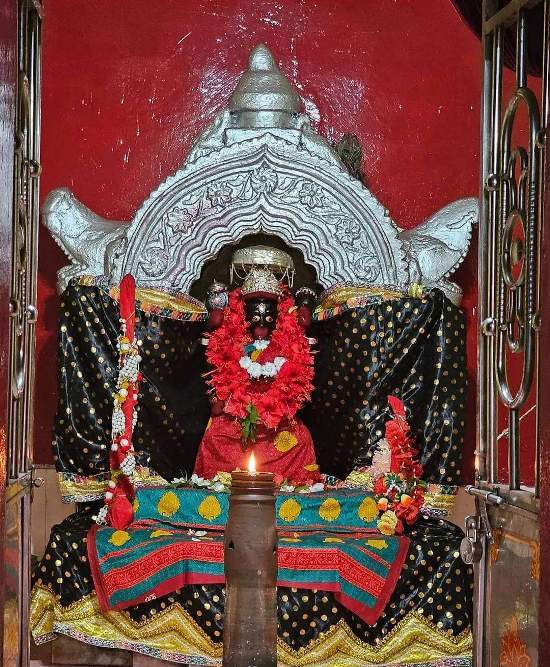
The Goddess Lankeswari is revered as the principal deity of the ancient capital of Junagarh and occupies a place of profound devotion in the hearts of the local people. Renowned as an important centre of Shakta and Tantric traditions, the shrine has long served as a significant spiritual and cultural institution in the region. Historically, Lankeswari was worshipped as the tutelary deity of several ruling dynasties, including the Chindaka Naga, Ganga, and Naga rulers, reflecting her enduring political and religious significance. Over the centuries, numerous legends and folklore narratives have emerged around the goddess, enriching the sacred heritage of the temple and strengthening its place in the collective memory of the region.
According to a widely cherished local tradition, the Banka Paikas, a renowned warrior community, brought the idol of Goddess Lankeswari from the southern region at the command of the reigning king. The legend narrates that after achieving victory over their adversaries, the Banka warriors ceremoniously escorted the deity to the capital city of Jenabalipatana (present-day Junagarh). Their triumphant return was marked by the resonant beats of the traditional Ghumura martial drum, symbolizing valor, devotion, and royal prestige. This narrative continues to occupy an important place in the cultural memory and folk heritage of the region.
Historians often associate this legend with the period during which the Ganga rulers are believed to have defeated the Kalachuris and restored the territories of their allies, the Chindaka Nagas, in the Bastar region. Some scholars suggest that the tradition of bringing Goddess Lankeswari to Junagarh may have originated from this historical context. In medieval India, it was a well-established custom for victorious monarchs to transport revered deities from conquered or reclaimed territories and install them in their own capitals. Such acts symbolized not only military success and political authority but also the transfer of divine protection and legitimacy to the ruling dynasty. The legend of Lankeswari’s arrival at Junagarh may therefore preserve a cultural memory of these historical and political developments.
The period between the 10th and 12th centuries CEwitnessed significant political upheaval across the regions of Trikalingaand South Kosala. This era was characterized by frequent military conflicts and shifting alliances among powerful dynasties such as the Somavamsis, Kalachuris, Chindaka Nagas, and Gangas. The principal cause of these prolonged struggles was the intense rivalry among these ruling houses for supremacy and the prestigious title of “Trikalingadhipati” (Lord of Trikalinga). These contests for political dominance profoundly influenced the historical, cultural, and territorial landscape of eastern and central India during the medieval period.
The abundance of Sati stones and Hero stones found in and around Junagarh serves as a significant testament to the region’s long history of warfare and martial traditions. These memorials commemorate acts of bravery, sacrifice, and devotion, reflecting the turbulent political conditions that prevailed during different periods of its past. In local tradition, Goddess Lankeswari is revered as a powerful war deity, believed to bestow courage, victory, and protection upon warriors engaged in battle. Popular folklore further portrays the goddess as an active divine force who not only guided her devotees to success but also symbolically accompanied them on the battlefield, embodying the martial spirit and protective power associated with her worship.
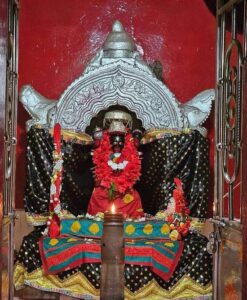
Based on its iconographic characteristics and artistic style, scholars have dated the image of Goddess Lankeswari to approximately the 12th century CE. The deity is depicted with four armsandis seated gracefully in the Vajraparyanka posture upon a lotus pedestal. In her upper hands, she bears the Sankha (conch) and Chakra (discus), symbols traditionally associated with divine power and protection. Her lower right hand is shown in the Varada Mudra, signifying benevolence and the granting of blessings, while her lower left hand is displayed in the Abhaya Mudra, symbolizing fearlessness and divine assurance.
The image is further distinguished by its protruding tongue, a characteristic feature that reflects the goddess’s fierce and protective aspect within the Shakta tradition.
The image of Goddess Lankeswari is sculpted from black chlorite stone and measures approximately 32 inches in height and 16 inches in width. One of the most remarkable aspects of this icon is its unique fusion of Shakta and Vaishnavite elements, combining features traditionally associated with Goddess Kaliand Lord Vishnu. Such an iconographic synthesis is exceptionally rare and is regarded as unique within the religious art of Odisha.
The goddess is traditionally worshipped through the recitation of the Vanadurga Bija Mantra, reflecting her Tantric and Shakta significance. Situated in front of the main shrine, outside the temple premises, is an imposing four-armed image ofKali. The deity is portrayed in a dynamic dancing posture upon a corpse, symbolizing the triumph of divine power over ignorance and mortality. She carries a swordand a severed head in two of her hands, while the other hands hold a skull cup and a noose, attributes commonly associated with her fierce and transformative nature.
Accompanying the goddess is Budharaja, who is revered as the Bhairavaand guardian deity of the shrine. As the divine protector of the sacred precinct, Budharaja occupies an important place in the ritual and religious traditions associated with the worship of Goddess Lankeswari.
According to local traditions and historical accounts, certain ritual practices associated with warfare and royal authority were believed to have existed in earlier times, including the ceremonial sacrifice of defeated rulers and other forms of human offerings. These customs were often linked to the religious and socio-political beliefs of their respective eras. However, such practices belong entirely to a distant historical past and have long since disappeared. Today, they survive only as elements of folklore, legend, and historical memory, representing chapters of history that are no longer part of contemporary religious or cultural life.
The most significant festival associated with GoddessLankeswariis Khandabasa, which is observed on the sacred night of Mulastami.
The celebration is marked by a series of elaborate religious ceremonies and esoteric rituals performed in accordance with long-established temple traditions. Following the completion of these sacred rites and special worship, the ceremonial swords of the goddess are ritually installed beside the altar. Traditionally, this important act is carried out by theMaharaja or a designated representative of the royal family, who places the swords upon two carefully arranged heaps of rice positioned on either side of the sanctified altar. The ceremony symbolizes the divine authority, protective power, and martial heritage associated with the goddess and her worship.
According to the Chief Priest Of the Lankeswari temple of Junagarh, Shri Anil Kumar Panda , the position of the ceremonial sword during the Khandabasa ritual is regarded as an auspicious indicator for the well-being of the region. It is traditionally believed that if the sword remains perfectly upright, it signifies prosperity, peace, and protection from natural calamities in the coming year. Conversely, if the sword tilts to either side, it is interpreted as a warning of potential adversity or unfavorable events. Beyond its ritual significance, the Khandabasa Festival holds immense cultural importance as it marks the commencement of the Saradiya Mahotsav in Kalahandi, inaugurating a season of religious observances, festivities, and community celebrations across the region.
Following the relocation of the Kalahandi capital from Junagarh to Bhawanipatnaduring 1849–1850, prompted by a severe epidemic that afflicted the region, Goddess Manikeswariemerged as the principal deity of the royal family. In doing so, she assumed the role previously held by Goddess Lankeswari, who had long served as the ancestral tutelary deity of the Naga dynasty.
Despite this shift in royal patronage, Lankeswari retained her profound significance among the people of the region. She continues to be worshipped with deep reverence and devotion, while also inspiring a sense of awe and respect across all sections of society. Her enduring influence in local religious life is reflected in the widespread belief that invoking her name carries great sanctity. Even today, many people are reluctant to make a false oath in the name of Goddess Lankeswari, a testament to the unwavering faith and trust placed in her divine authority and protective power.
Siddharth Saswat Panda Junagarh , Kalahandi Contact :- +91 9437773129 / +91 9437362929
Gmail :- [email protected]